What a Consumer Wearable Does Not Tell You About Hormones
A wearable displays “deep sleep,” but the display is an estimate produced from sensor information and software. It is not a direct growth-hormone measurement. Keep the device output, the feature’s intended use and your own symptoms separate when deciding what to bring to a clinical discussion.
On this page
- Follow the path from signal to interpretation
- Keep validation and clearance tied to the named feature
- A changed display with an unchanged concern
- Do not edit the diary to agree with the screen
- Bring a report that can be understood in context
- A consumer sleep display is not a GH assay
- Sources and reading context
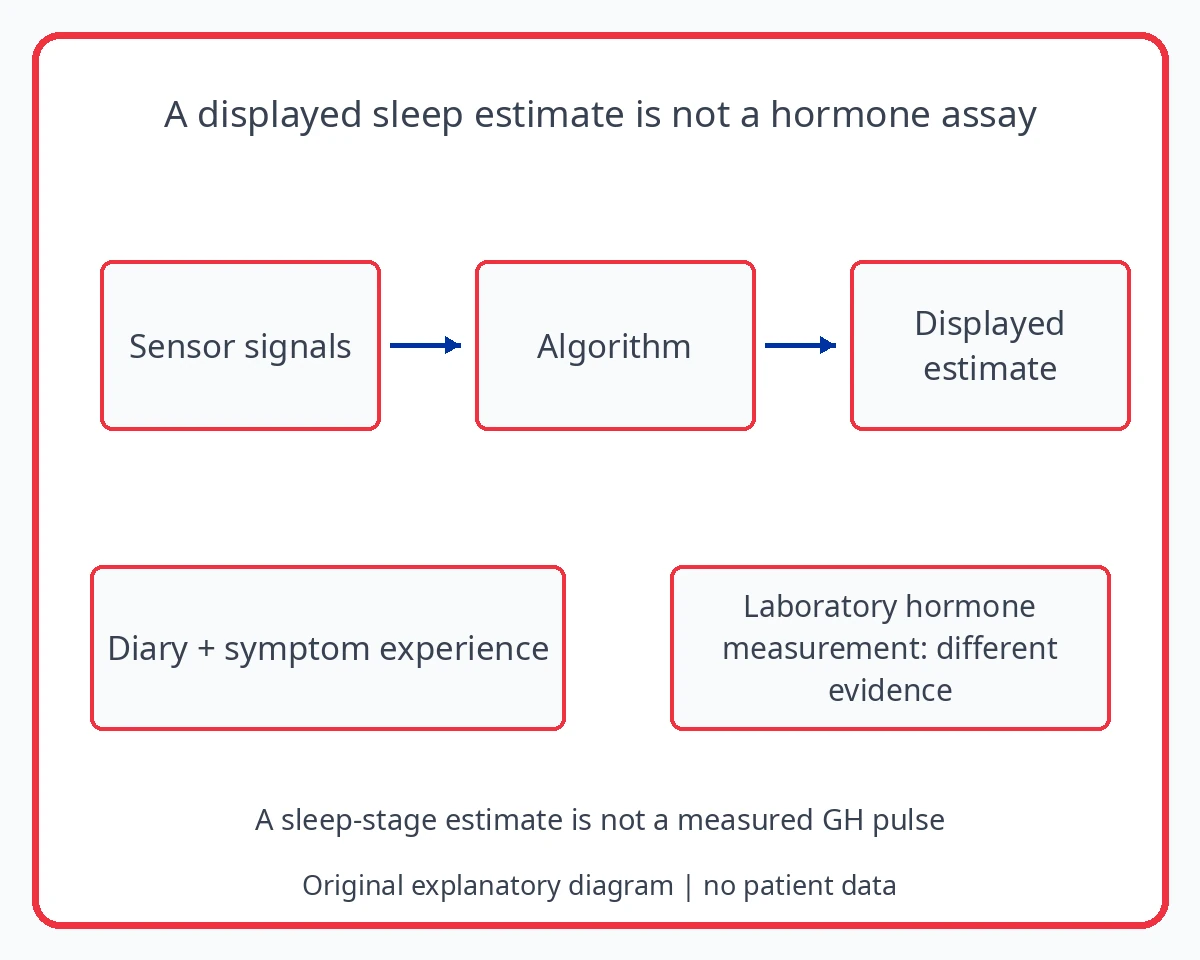
Follow the path from signal to interpretation
Google’s research description provides a concrete device example: sleep algorithms use accelerometer information and inter-beat intervals derived from an optical pulse signal. This describes the studied Google/Fitbit systems, not every consumer device. The sensed signal, software classification and displayed estimate are different layers; a sleep-stage label is not a measured hormone pulse.
AASM’s advisory addresses consumer technologies used to assess obstructive sleep-apnea risk and emphasizes their limits. It does not validate every sleep feature on every device. Read the description of the particular feature you are using, including what it estimates and which interpretation the manufacturer says it is intended to support. [1] [3]
For interpreting indirect measurements more broadly, read A Biomarker Change Is Not the Same as a Health Benefit
For the physiological and clinical context behind GH measurements, read HGHThai’s GH and IGF-1 explanation
Keep validation and clearance tied to the named feature
AASM notes that some apps or devices have US FDA clearance for sleep-apnea self-screening or risk assessment. That is a defined use, not validation of every number shown by the same device. The advisory also distinguishes these outputs from diagnosis or confirmation that apnea is absent. Do not extend a claim about one feature to a GH estimate.
Preserve the device model, feature name and software context when sharing a report. If you do not know what changed after an update, leave that uncertainty visible. Avoid the opposite overstatement too: saying a consumer device is not a hormone assay does not mean every consumer health feature has no useful evidence or purpose. [1]
A changed display with an unchanged concern
This fictional example does not evaluate any named device’s accuracy. It separates kinds of information for discussion.
| Evidence or observation | What is available | How to interpret it |
|---|---|---|
| Device output | More time labelled “deep sleep” than before | An algorithm-derived sleep estimate |
| Person’s experience | Still feels unwell during the day | A separate symptom observation |
| Hormone claim | No GH laboratory result is available | The display cannot supply a measured GH change |
| Device context | Model, feature and software details retained | Needed to identify what produced the report |
| Clinical question | How should the symptoms and report be considered? | No diagnosis follows from the score alone |
Do not edit the diary to agree with the screen
In the fictional case, the display appears to improve while the person still feels unwell. Changing the symptom diary to match the score would lose useful information. Keep the actual report and the person’s experience as separate observations, with their dates.
The discrepancy may prompt a question about the feature, the sleep pattern or the symptoms. It does not establish that GH secretion increased, that the person should feel better or that the concern can be dismissed. The screen cannot answer a question it does not measure.
For the distinction between apnea risk information and diagnosis, see Sleep Apnea and Fatigue: Questions to Raise With Your Clinician
Bring a report that can be understood in context
NHLBI’s sleep diary adds information such as timing, perceived sleep and daytime sleepiness for clinical review. Keep estimates marked as estimates. If the clinician wants device data, bring the actual report rather than a cropped score that omits dates or the feature name. The diary and device may describe different aspects of the night.
Persistent or concerning symptoms still need appropriate assessment. A reassuring output should not delay that discussion, and an alarming output should not become a self-made treatment plan. This article does not rate a named wearable or diagnose a sleep or endocrine disorder; it explains the boundary between a displayed estimate and the evidence needed for another claim. [2]
A consumer sleep display is not a GH assay
This article does not evaluate a named device’s accuracy or diagnose a sleep or endocrine disorder. No ordinary sleep score is used as a GH test.
Sources and reading context
- AASM sleep-app apnea risk assessment position — Apnea-risk assessment and its limits; FDA clearance applies to specific features.
- NHLBI sleep diary — Record sleep for discussion; cannot measure GH or diagnose fatigue
- Google Research: sleep-tracking algorithms on Google and Fitbit wearables — Manufacturer research example: accelerometer and optical pulse-derived inter-beat intervals feed sleep algorithms. Not validation of every device, feature or a GH measurement.