Sleep Apnea and Fatigue: Questions to Raise With Your Clinician
A partner reports repeated gasping at night, but the wearable shows no alert. Those facts do not cancel each other out. Breathing-related sleep observations and daytime sleepiness deserve clinical discussion; a consumer notification is a separate source of information, not a diagnosis or proof that no problem exists.
On this page
- Describe the observation and who noticed it
- Make the assessment question specific
- Symptoms remain relevant when a device gives no alert
- A reassuring display should not erase the person’s experience
- Know which role the wearable feature is intended to serve
- Neither a diary nor a risk notification supplies a diagnosis
- Sources and reading context
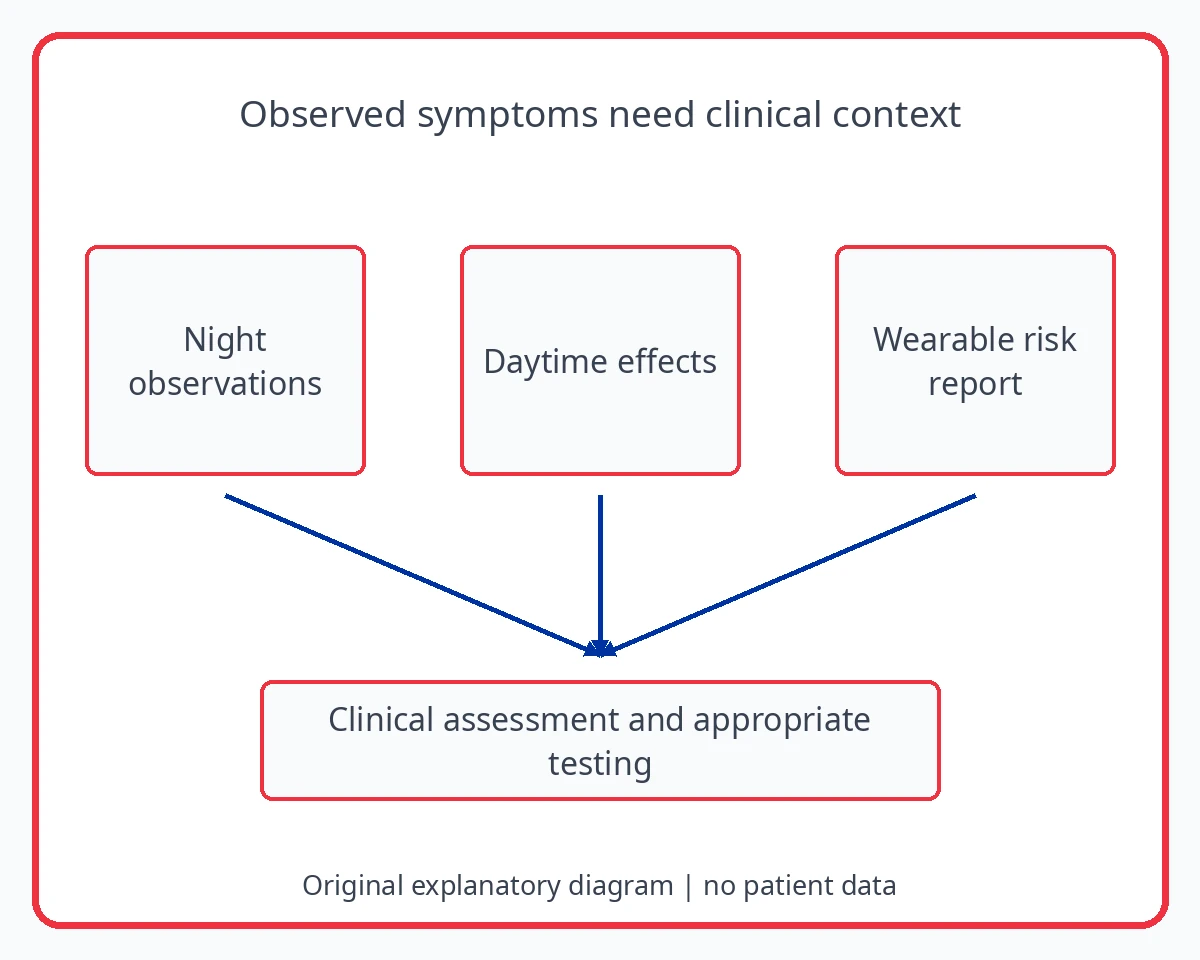
Describe the observation and who noticed it
The NHS lists breathing pauses, gasping or choking noises and loud snoring among sleep-apnea symptoms, with possible daytime effects. Record what was noticed, roughly when and by whom. If someone says the breathing “seemed to stop,” preserve that description rather than converting it into an exact event count or severity grade.
A person may not remember an event observed while they were asleep. That makes the observer’s account useful context, not a reason to invent a more precise record. Keep daytime experience alongside it: an urge to doze, difficulty concentrating or another concern. Snoring alone does not establish a diagnosis, and one quiet or unobserved night does not resolve the pattern. [1]
Make the assessment question specific
The NHS describes clinical assessment and, where appropriate, testing through sleep services. Ask what the proposed test measures, whether it is performed at home or elsewhere and how the result will be explained. Those are questions for the service handling the assessment; this article does not prescribe a test or transfer the NHS referral process to another country.
Bring relevant medical and medicine information with the symptom history. If daytime sleepiness affects safe driving or work, raise that explicitly and arrange a safe alternative to the affected activity. Do not wait for a device alert or a complete diary before seeking assessment of persistent or concerning symptoms. [1]
Symptoms remain relevant when a device gives no alert
This fictional record explains how to describe observations. It is not a recommended sleep schedule, a clinical measurement or a diagnostic test.
| Part of the record | Fictional observation | How to describe it |
|---|---|---|
| Night observation | Partner reports repeated gasping on two nights | Observer account; no clinical event count assigned |
| Daytime effect | Person feels very sleepy during ordinary activities | Include the effect on safe travel or work |
| Wearable result | No risk notification shown | Does not rule out sleep apnea |
| Missing information | No clinical test result yet | Do not label severity or assume a diagnosis |
| Next discussion | Ask what assessment is appropriate | Keep symptoms and device data as separate inputs |
A reassuring display should not erase the person’s experience
In the fictional record, the partner’s observation and the person’s sleepiness are still present. The absence of a wearable alert does not establish that the breathing observations were mistaken. Nor do those observations alone supply a diagnosis. They give the clinician reasons to ask further questions and consider assessment.
Save the actual device report if it is relevant, with the feature name and date. Avoid translating “no notification” into “normal clinical test.” That change in wording would give the device output a meaning the record does not support.
For describing daytime symptoms without assuming their cause, see A Symptom Diary for an Endocrine Appointment: What to Record
Know which role the wearable feature is intended to serve
AASM’s 2025 statement addresses consumer technologies that assess obstructive sleep-apnea risk. A risk-assessment feature and a clinical diagnosis are different things. Read the intended use and limitations of the particular feature rather than assuming every sleep display on the device has the same purpose or validation.
Keep the device name and software context available if the clinician wants to review the report. If the device output and symptoms disagree, retain both. This article does not interpret breathing symptoms as GH deficiency or choose treatment; it helps keep the information accurate enough for the next clinical discussion. [2]
For how wearables infer their displayed results, see What a Consumer Wearable Does Not Tell You About Hormones
Neither a diary nor a risk notification supplies a diagnosis
This article does not diagnose sleep apnea or provide a treatment plan. It does not interpret sleep symptoms as evidence of GH deficiency.
Sources and reading context
- NHS sleep apnoea — Symptoms to discuss and professional assessment; no self-diagnosis
- AASM sleep-app apnea risk assessment position — Apnea-risk assessment and its limits; FDA clearance applies to specific features.