Training Fatigue: Information That Helps a Health Assessment
A familiar route now feels harder after illness and disrupted sleep, while the training log also shows more sessions. The useful record keeps all three changes visible. Calling the pattern “low GH” or “overtraining” would skip the assessment needed to understand why ordinary activity has changed.
On this page
- Define the usual pattern before describing the difference
- Keep illness, sleep and workload as separate observations
- A changed route experience with several possible influences
- The log should not choose a single explanation in advance
- Ask for a plan while the concern is being assessed
- The record describes a change; it does not establish a syndrome
- Sources and reading context
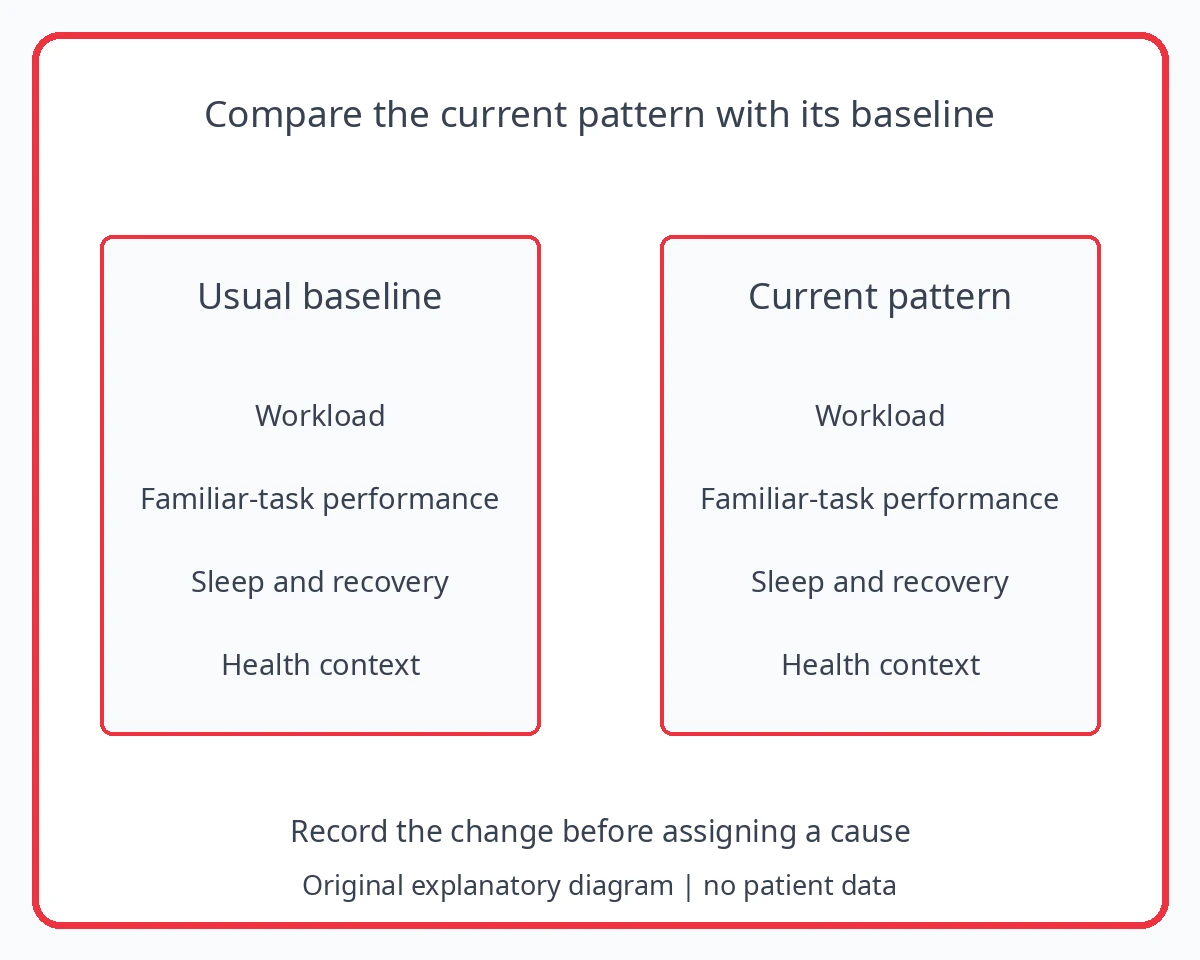
Define the usual pattern before describing the difference
MedlinePlus discusses changes in performance and recovery among concerns associated with excessive exercise. To make a comparison useful, describe the person’s usual activity and what changed in frequency, duration or effort. A general phrase such as “fitness crashed” does not show which task became harder or how the current period differs.
Choose a familiar task when possible and note important changes in conditions. If the route, load or weather differs, say so. The diary records experience; it does not create a controlled experiment. Avoid adding an invented percentage decline when only an ordinary description of greater effort is available. [1]
For recording individual sessions clearly, use Recording Exercise and Recovery for a Medical Review
Keep illness, sleep and workload as separate observations
MedlinePlus describes fatigue as having many possible causes. Relevant illness, sleep disruption, pain, medicine changes or mood concerns belong alongside the activity record. More than one factor can be present. Their order in the diary does not decide which factor caused the difficulty.
Record known changes and uncertainty honestly. “More sessions this week” is different from a measured increase in total workload, especially if session duration or intensity is unknown. Do not infer that the training load stayed identical merely because the same route name appears in the log. The detail should make alternative explanations easier to discuss. [2]
A changed route experience with several possible influences
This fictional comparison is a discussion aid. It is not an overtraining score, a diagnosis or a return-to-activity plan.
| Evidence or observation | What is available | What it does not establish |
|---|---|---|
| Usual baseline | Familiar route generally felt manageable | An ordinary comparison, not a laboratory measure |
| Current task | Same route feels harder on recent outings | Describe the experience and timing |
| Training context | More sessions recorded; total workload not calculated | Frequency alone does not quantify all load |
| Health context | Recent illness and disrupted sleep also recorded | Neither is assigned as the cause |
| Review question | What assessment and activity guidance are appropriate? | No hormone diagnosis follows from the log |
The log should not choose a single explanation in advance
The fictional person has several changes at once: more recorded sessions, recent illness and disrupted sleep. Removing two of those details would make the remaining explanation look stronger without adding evidence. Keeping them separate gives the professional a clearer account of what needs assessment.
The person can describe when the familiar route began to feel harder and what other activities are affected. They do not need to repeat a difficult workout to prove the concern, or let a normal-looking device score override what they are experiencing.
Ask for a plan while the concern is being assessed
Summarize when the change began, which activities it affects and what prompted the appointment. Bring the fuller record and existing clinical instructions. Ask what activity guidance applies during assessment and how to follow up if the concern persists or changes. Record advice actually received separately from a question still waiting for an answer.
This record does not diagnose overtraining, RED-S or GH deficiency and supplies no training progression. The goal is a useful clinical conversation about the change from baseline. A well-organized log can support that discussion while leaving the cause unresolved.
For describing symptoms beyond the training log, see A Symptom Diary for an Endocrine Appointment: What to Record
The record describes a change; it does not establish a syndrome
This guide does not diagnose overtraining, RED-S or GH deficiency. It supplies no exercise progression, hormone treatment or return-to-training rule.
Sources and reading context
- MedlinePlus overtraining — Training recovery observations, not GHD or RED-S diagnosis
- MedlinePlus fatigue — Fatigue versus drowsiness and broad clinical context; no GH-deficiency diagnosis from tiredness