Recording Exercise and Recovery for a Medical Review
Two exercise sessions can each last forty minutes and feel very different. For a medical review, record the activity, the effort and the recovery rather than minutes alone. The useful detail is how the experience compares with your usual activity and what changed afterwards.
On this page
- Describe the activity and how demanding it felt
- Record recovery as its own part of the experience
- Equal minutes, different sessions
- The missing route detail changes the comparison
- Use a familiar task to explain the practical change
- A session log does not diagnose the reason for a change
- Sources and reading context
Describe the activity and how demanding it felt
CDC’s intensity guidance includes the talk test as one way to describe relative effort. For a record of activity already performed, note the type, duration and an ordinary description of how it felt. Do not turn the description into a new challenge or push harder to find out whether you cross an intensity category.
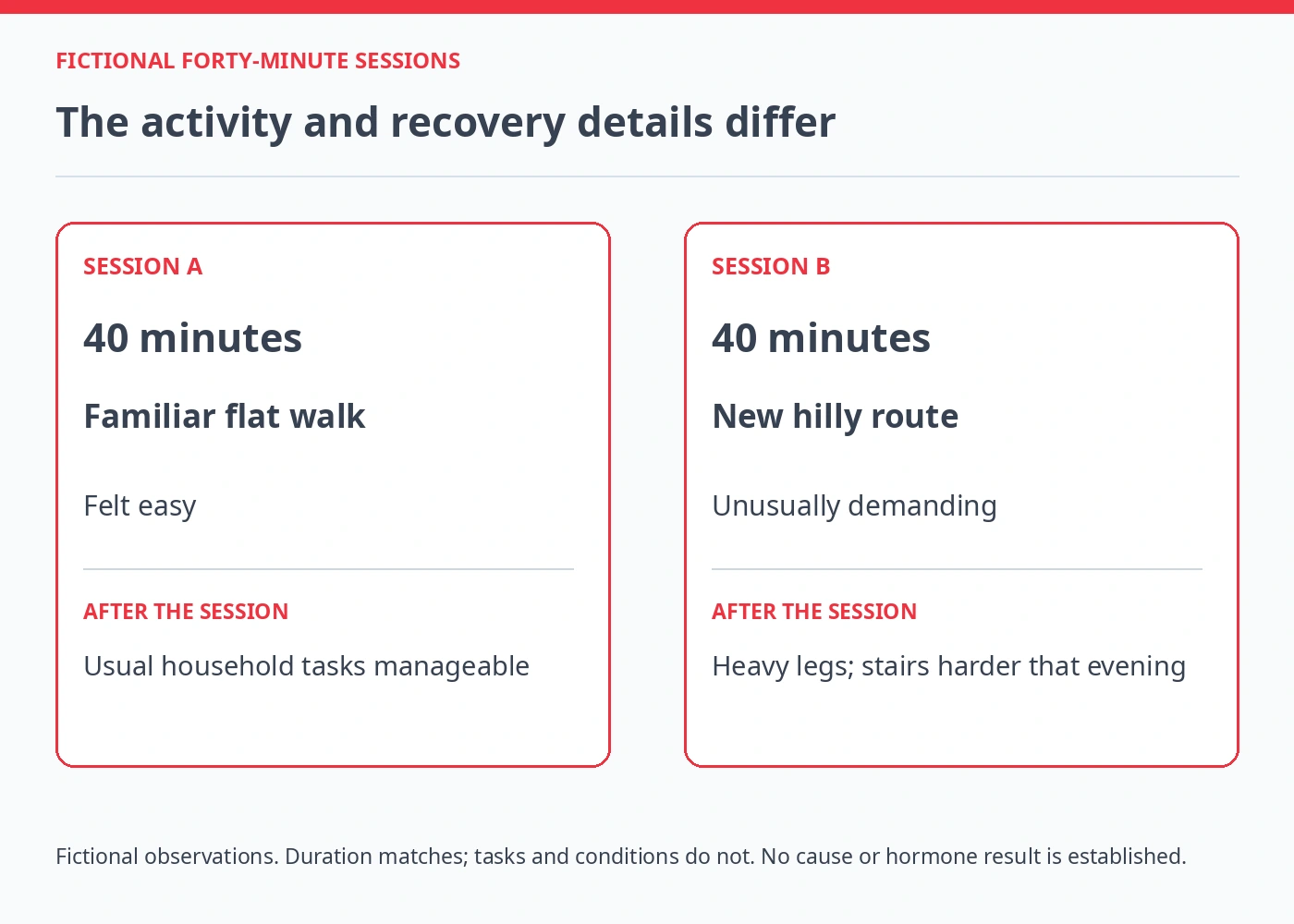
Keep the setting visible when it matters. A familiar flat walk and a new hilly route are different tasks even if both take forty minutes. If the route or conditions changed, record that instead of presenting the sessions as a controlled comparison. A device score may be additional information, but it does not measure a hormone level. [1]
Record recovery as its own part of the experience
MedlinePlus describes changes in performance, rest needs, soreness, sleep and mood among concerns associated with excessive exercise. Those observations do not identify a diagnosis on their own. Write which change occurred, how long it lasted and whether it affected ordinary tasks after the session. “Recovery was poor” is less informative than a concrete description.
Include relevant illness or a change in training alongside the recovery note. Avoid deciding that one difficult session proves overtraining or GH deficiency. The record should allow the reviewer to see the sequence and ask about alternatives, including whether the sessions were comparable in the first place. [2]
Equal minutes, different sessions
This fictional example is a recording or evidence-reading exercise. It does not diagnose a condition or recommend a product, diet or exercise program.
| Observation or question | Available detail | What remains separate |
|---|---|---|
| Session A | 40-minute familiar flat walk; felt easy | Record the activity and effort together |
| After A | Usual household tasks felt manageable | A separate recovery observation |
| Session B | 40-minute new hilly route; felt unusually demanding | Task and terrain differ from A |
| After B | Legs felt heavy later; stair climbing harder that evening | Describe timing and practical effect |
| Interpretation | Minutes match, conditions do not | No controlled comparison or hormone diagnosis |
The missing route detail changes the comparison
If both fictional sessions are entered only as “40 minutes exercise,” the record makes them look equivalent. Adding the new hilly route shows why duration alone cannot explain the difference in effort. The later heavy-leg and stair-climbing observations remain useful, but they do not establish their cause.
A clearer appointment note says what was different and what prompted concern. It does not translate the experience into a recovery percentage or repeat the demanding session to test a hormone theory. The clinician can consider the observations with the person’s wider health history.
For changes across several training sessions, see Training Fatigue: Information That Helps a Health Assessment
Use a familiar task to explain the practical change
HealthLink BC recommends describing symptoms and their effects specifically. A usual task can make the concern understandable: whether walking the ordinary route, carrying shopping or climbing familiar stairs has changed. Keep the task and context similar enough that the comparison is meaningful, and state when they are not.
Bring relevant medicines and existing clinical instructions to the discussion. Ask what assessment and activity guidance apply while the concern is reviewed. New or worrying symptoms should be assessed appropriately, rather than deliberately provoked through harder exercise. This article supplies a recording method, not a training progression or recovery target. [3]
During prescribed care, connect observations with agreed goals using Reviewing Treatment Goals and Benefits With Your Clinician
A session log does not diagnose the reason for a change
No training program, recovery target or hormone intervention is recommended. New or concerning symptoms should be assessed appropriately rather than tested through harder exercise.
Sources and reading context
- CDC measuring physical activity intensity — Relative intensity/talk-test concept, not an individualized exercise prescription
- MedlinePlus overtraining — Training recovery observations, not GHD or RED-S diagnosis
- HealthLink BC working with your doctor — Describe symptoms and daily effects; not a diagnostic instrument