Tracking a Realistic Sleep Routine Without Chasing Hormone Numbers
A bedtime routine can become more consistent while daytime sleepiness remains a problem. Record both. The useful question is whether the routine is workable and how the person functions during the day, not whether a neat schedule implies an improved hormone level.
On this page
- Distinguish time awake from the body’s timing signals
- Write down the routine that is actually feasible
- A more consistent routine with a persistent daytime concern
- An improved habit and an unresolved symptom can coexist
- Choose a useful daily-life question for review
- Routine consistency is not a laboratory result
- Sources and reading context
Distinguish time awake from the body’s timing signals
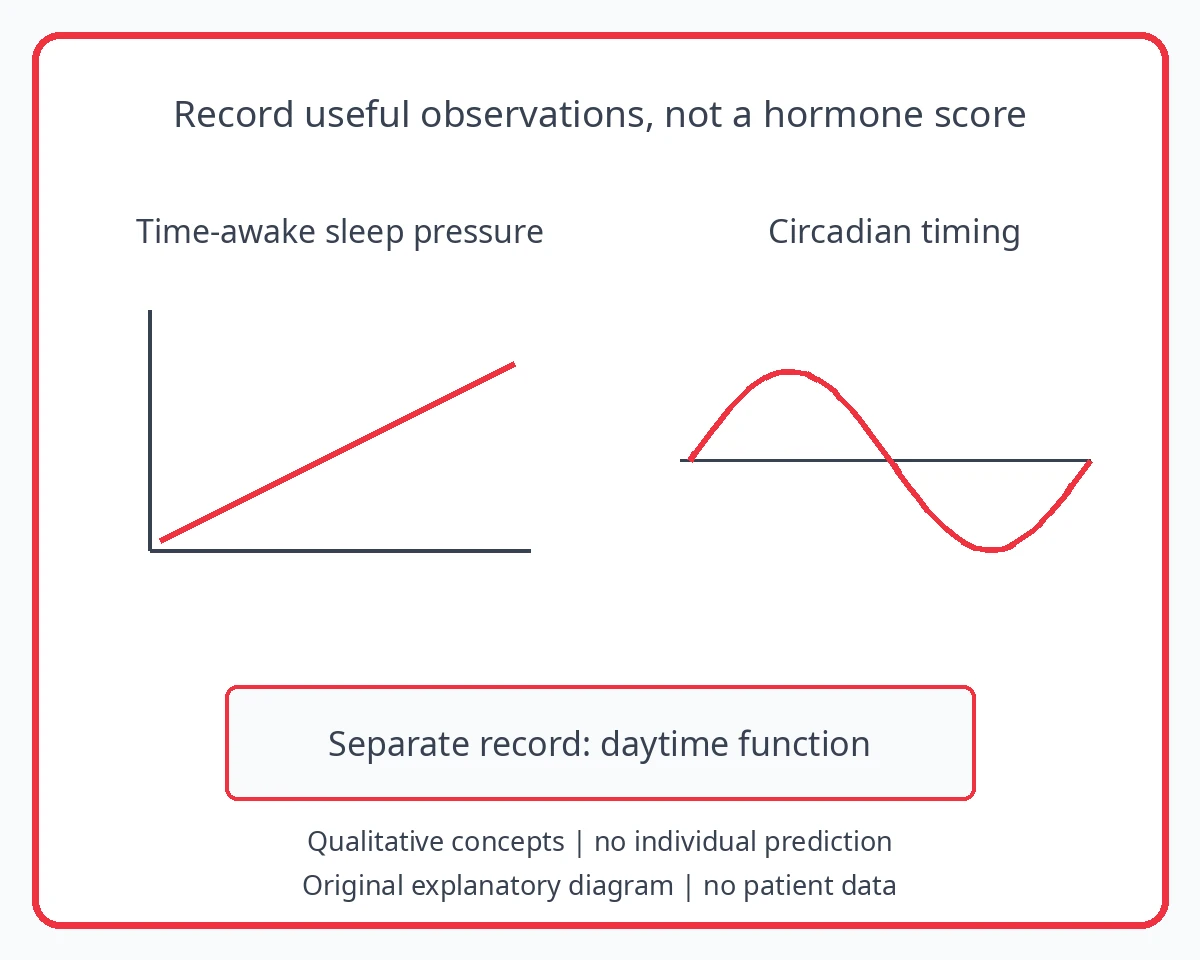
NHLBI describes sleep pressure and circadian timing as different influences on the sleep-wake cycle. Time spent awake and the body’s daily timing signals are related to sleep but are not the same variable. That distinction helps explain why adding up hours alone does not describe the whole pattern.
The image illustrates these concepts qualitatively. It is not an individual prediction of sleep stages, a hormone curve or a formula for an ideal bedtime. If a record includes daytime sleep or split episodes, keep their timing visible rather than forcing them into a diagram designed for one night of uninterrupted sleep. [1]
Write down the routine that is actually feasible
NHLBI’s healthy-sleep guidance discusses consistent timing and supportive habits. A practical record should include the routine being attempted and the responsibilities that affect it. A caregiver, shift worker and someone with a flexible daytime schedule may face different constraints. Naming the constraint is more useful than labelling every interruption a failure.
Separate intention from observation. “Aim to begin winding down at 22:00” is a plan, while “started at 22:30 because of a caregiving task” is what happened. Neither entry establishes when sleep began. Keep bedtime, estimated sleep and interruptions as their own observations if the clinical team wants that detail. [2] [3]
A more consistent routine with a persistent daytime concern
This fictional example records a routine change and a symptom separately. It does not prescribe a bedtime or validate a sleep or hormone score.
| Evidence or observation | What is available | What it does not establish |
|---|---|---|
| Routine intention | Begin winding down at a similar time | A practical plan, not a sleep measurement |
| Observed change | Bedtime entries became more consistent | Does not prove sleep quality or hormone change |
| Constraint | Caregiving interrupted the routine on one evening | Record context rather than erase the day |
| Daytime experience | Strong sleepiness still affects reading and meetings | The concern remains relevant |
| Next discussion | Ask how to assess the persistent sleepiness | A “good routine” label should not close the question |
An improved habit and an unresolved symptom can coexist
In the fictional record, the person followed a more consistent bedtime pattern but still struggled with sleepiness during the day. It would be misleading to describe the problem as solved because the routine column looks better. The observation about consistency and the symptom report answer different questions.
Bring both to the discussion, including the caregiving interruption and uncertainty about actual sleep. The record can show something became easier while also showing that further assessment is needed. There is no need to turn the result into a success or failure score.
For routines affected by shift work, see Tracking Sleep and Fatigue When You Work Shifts
Choose a useful daily-life question for review
A sleep diary can connect timing with how the person experiences the following day. Describe the task affected and what has or has not changed. Avoid inventing a nightly GH score or assuming a difficult night diagnoses an endocrine problem. The record is more useful when its goal is a real concern the clinician can discuss. Use a symptom diary focused on ordinary tasks to explain the persistent concern alongside the sleep record.
Ask what additional information is needed and what support fits the practical constraints. Persistent or concerning symptoms deserve appropriate assessment even when some habits improve. This article supplies no individualized sleep treatment, stage target or hormone interpretation. [3]
For limits of device-derived sleep scores, read What a Consumer Wearable Does Not Tell You About Hormones
Routine consistency is not a laboratory result
No hormone level, sleep-stage target or individualized treatment plan can be inferred from this record. Persistent or concerning symptoms need appropriate assessment.
Sources and reading context
- NHLBI sleep-wake cycle — Sleep pressure and circadian timing, not a home GH score
- NHLBI healthy sleep habits — General sleep support, no hormone optimization promise
- NHLBI sleep diary — Record sleep for discussion; cannot measure GH or diagnose fatigue