Tracking Sleep and Fatigue When You Work Shifts
A night shift can cross midnight, and the following sleep may occur in two separate episodes. A form with one bedtime per calendar day can lose that structure. Put work and sleep on a dated timeline so the reader can understand when each event happened, not just the total number of hours entered.
On this page
- Record timing as well as accumulated hours
- Use a two-day view when one day hides the sequence
- One overnight shift and two later rest episodes
- A total can be correct while the description is misleading
- Bring the roster and the effects on ordinary tasks
- The example records a pattern; it does not recommend that pattern
- Sources and reading context
Record timing as well as accumulated hours
NHLBI explains that sleep-wake timing involves the body’s circadian system, while NIOSH describes sleep and safety challenges associated with shift work. Time available for sleep and its position in the day are different pieces of information. A daily total does not show whether rest followed a shift, preceded it or was interrupted by responsibilities.
Start with the actual roster: work start, work finish and the dates on both sides of midnight. Then add each sleep or time-in-bed episode separately. This is a record of what happened, not a proposed work-rest schedule. It should make the practical pattern readable without implying that the arrangement is adequate or suitable for everyone. [1] [2]
Use a two-day view when one day hides the sequence
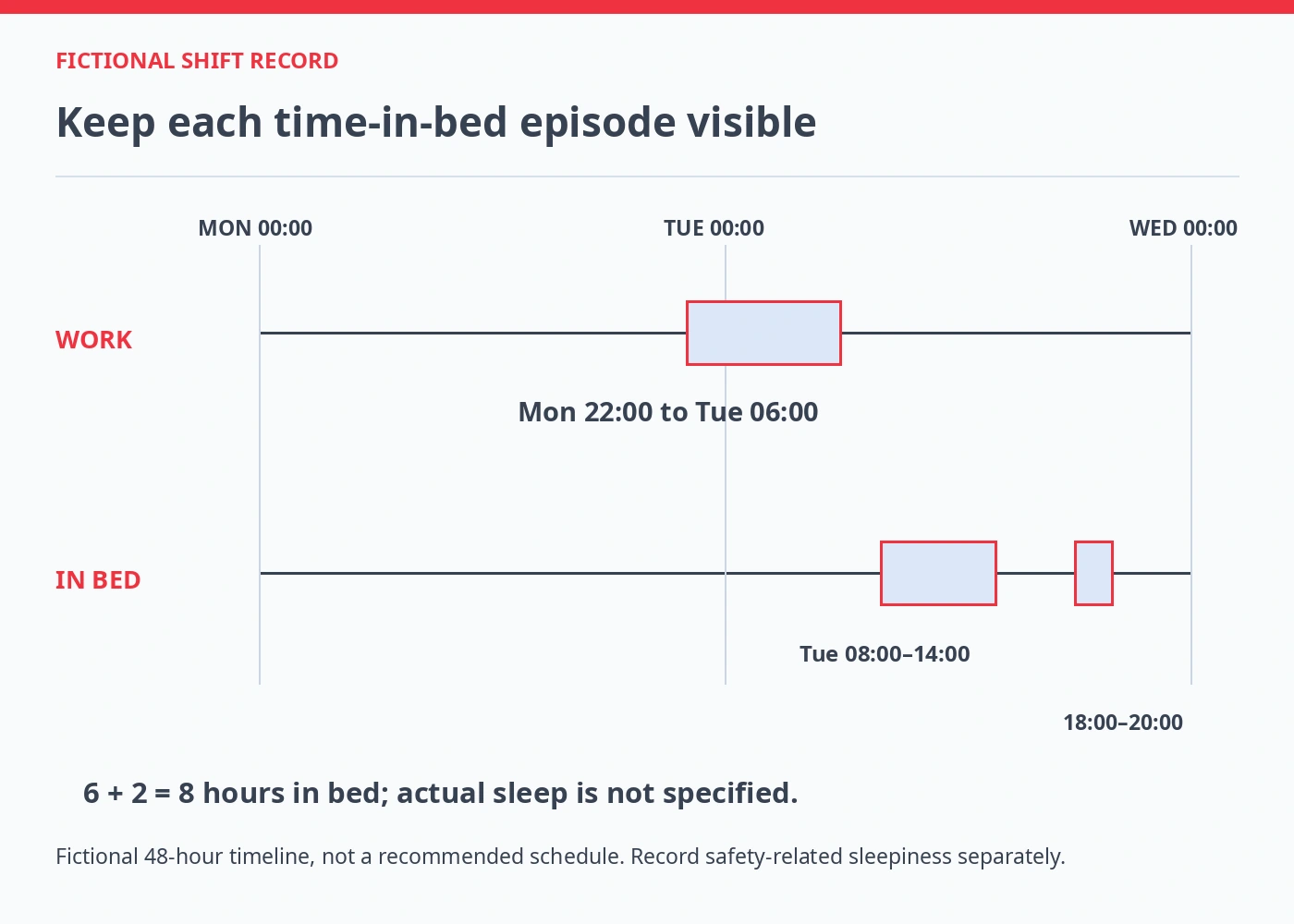
In the fictional example, work starts on Monday at 22:00 and ends Tuesday at 06:00. Tuesday has an 08:00–14:00 time-in-bed episode and another from 18:00–20:00. Those are two intervals, not one uninterrupted eight-hour sleep. Actual time asleep would need its own estimate for each episode.
A 48-hour display lets the dates and episodes stay together. If an app assigns sleep to the day it began or ended, retain that convention when exporting it. Do not silently move an episode to make the daily total match another system. The diary method helps separate time in bed, estimated sleep and periods whose details are unknown. [3]
One overnight shift and two later rest episodes
This fictional record explains how to describe observations. It is not a recommended sleep schedule, a clinical measurement or a diagnostic test.
| Part of the record | Fictional observation | How to describe it |
|---|---|---|
| Work | Monday 22:00 to Tuesday 06:00 | Overnight interval crosses a date boundary |
| First episode | Tuesday 08:00 to 14:00 in bed | 6 hours in bed; actual sleep not specified |
| Second episode | Tuesday 18:00 to 20:00 in bed | 2 hours in bed; retain as a separate episode |
| Total bed intervals | 6 plus 2 = 8 hours | Not evidence of eight continuous hours asleep |
| Daytime concern | Sleepiness during the commute is reported | A safety concern to address, not a hormone reading |
A total can be correct while the description is misleading
Adding the fictional bed intervals gives eight hours. Writing “slept eight hours after the shift” would nevertheless erase the split and assume all time in bed was sleep. The dated record keeps both episodes and leaves actual sleep estimates unknown until there is information to enter.
The commute concern also stays visible rather than being dismissed because the total looks sufficient. If sleepiness makes driving or another task unsafe, do not continue that activity as a test of endurance. Arrange a safe alternative and seek appropriate advice about the ongoing problem.
Use the sleep-versus-time-in-bed distinction in A Sleep Diary That Helps You Discuss Fatigue at an Appointment
Bring the roster and the effects on ordinary tasks
Record when sleepiness or fatigue affects work, travel or home responsibilities and whether the roster recently changed. Include relevant illness or medicine context without deciding which factor caused the problem. NIOSH’s shift-work material emphasizes fatigue and safety; a diary should help reveal the practical issue rather than normalize it. For the appointment note, use concrete descriptions of symptom timing and daily effects alongside the roster.
Discuss the pattern with a clinician or occupational-health service as appropriate. Ask what assessment and workplace or routine support fit the situation. This article does not design a shift schedule, prescribe naps or infer a GH level from daytime sleep. Its purpose is to preserve the sequence well enough for a useful conversation. [2]
For a routine record focused on daily function, see Tracking a Realistic Sleep Routine Without Chasing Hormone Numbers
The example records a pattern; it does not recommend that pattern
No individualized shift schedule, sleep prescription or hormone interpretation is provided. Significant sleepiness affecting safety needs appropriate professional attention.
Sources and reading context
- NHLBI sleep-wake cycle — Sleep pressure and circadian timing, not a home GH score
- CDC NIOSH shift work sleep training — Circadian/shift context; no universal individualized work-rest schedule
- NHLBI sleep diary — Record sleep for discussion; cannot measure GH or diagnose fatigue