A Sleep Diary That Helps You Discuss Fatigue at an Appointment
Being in bed from 23:00 to 07:00 gives an eight-hour interval, but it does not establish eight hours asleep. A useful sleep diary separates that interval from estimated time awake and the next day’s experience. It helps explain fatigue without turning a night’s record into a hormone result.
On this page
- Keep the clock interval and the sleep estimate separate
- Describe what “tired” means in daily life
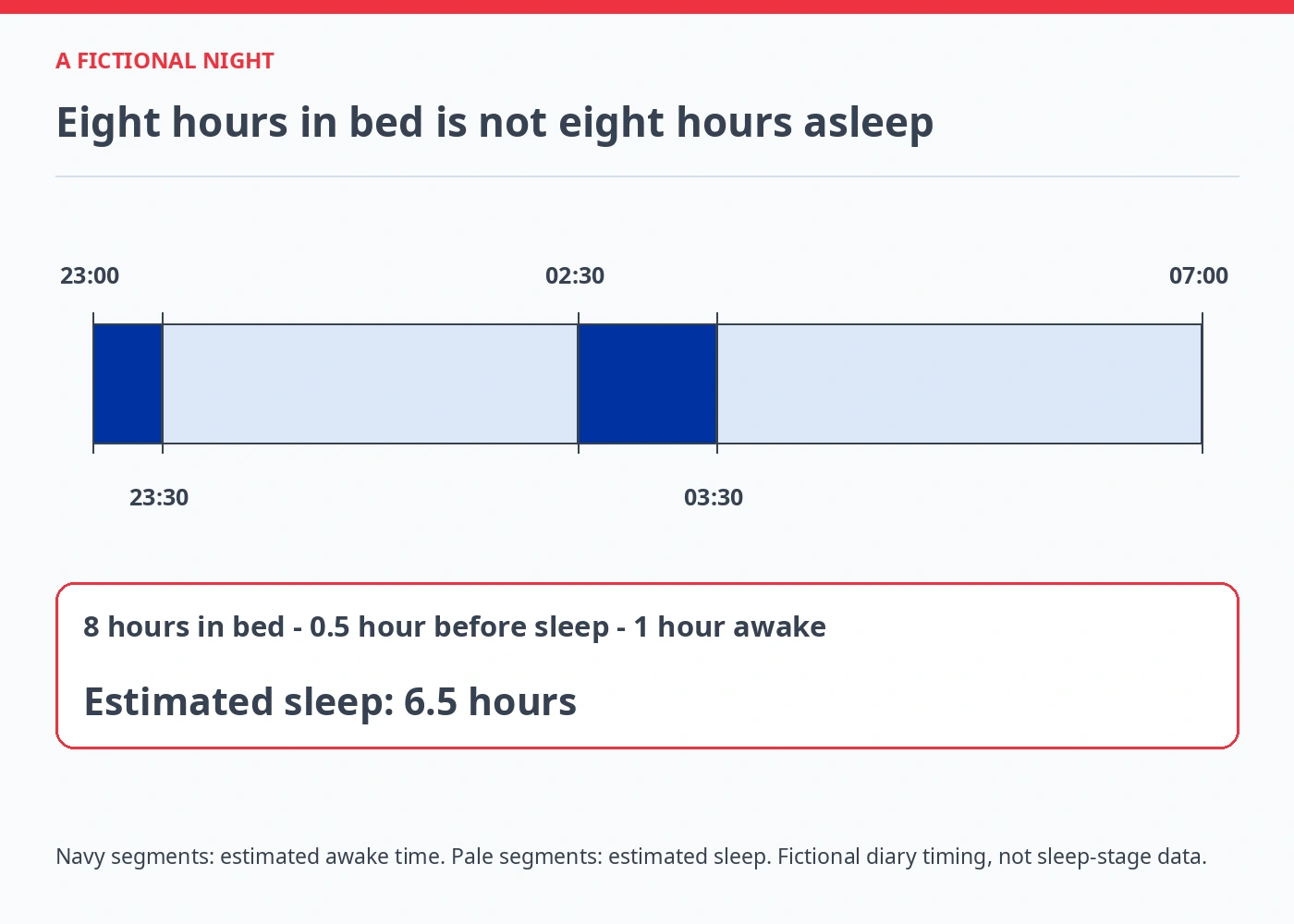
- Eight hours in bed, with estimated awake time
- Correct the label without pretending the estimate is exact
- Bring a useful pattern without waiting for a perfect diary
- A sleep estimate cannot diagnose the cause of fatigue
- Sources and reading context

Keep the clock interval and the sleep estimate separate
NHLBI’s sleep diary collects sleep information and daily context for discussion with a clinician. Record when you went to bed and got up, then separately note your estimate of time taken to fall asleep and time awake later. If the exact timing is uncertain, keep it approximate rather than borrowing precision from a clock or app.
In the fictional example, eight hours in bed includes half an hour before sleep and one hour awake later. Subtracting those awake periods gives an estimated 6.5 hours asleep. This is a diary calculation based on remembered periods, not a laboratory measurement of sleep. It does not reveal sleep stages or how much growth hormone was secreted. [1]
Describe what “tired” means in daily life
MedlinePlus distinguishes fatigue from drowsiness and describes fatigue as a symptom with many possible causes. An urge to fall asleep, low energy and difficulty sustaining an activity can be different experiences. Use ordinary descriptions: when the problem occurs, what you were doing and whether it differs from your usual day.
Keep the next-day observation separate from the explanation. “Nearly fell asleep while reading in the afternoon” is an observation; “my hormones were low” is an unconfirmed interpretation. A short, concrete entry gives the clinician something to ask about. There is no need to invent a severity score if you were not asked to use one. [2]
Eight hours in bed, with estimated awake time
This fictional record explains how to describe observations. It is not a recommended sleep schedule, a clinical measurement or a diagnostic test.
| Part of the record | Fictional observation | How to describe it |
|---|---|---|
| Bed interval | 23:00 to 07:00 | 8 hours in bed |
| Before sleep | Estimated 23:00 to 23:30 | About 0.5 hour awake |
| Later wakefulness | Estimated 02:30 to 03:30 | About 1 hour awake |
| Estimated sleep | 8 minus 0.5 minus 1 = 6.5 hours | Approximate diary estimate, not a measured sleep-stage total |
| Next day | Strong urge to doze while reading at 15:00 | Record the experience without assigning a hormone cause |
Correct the label without pretending the estimate is exact
The fictional entry originally says “slept eight hours.” The clock interval supports “eight hours in bed,” while the remembered awake periods support an approximate sleep estimate of 6.5 hours. Keeping both descriptions is more informative than replacing one confident number with another.
If the person is unsure when the later waking started, the diary should say so. The next-day sleepiness remains relevant even if the timing is imperfect. Do not change the record to agree with a device score or assume that a tidy total explains why the symptom occurred.
If breathing-related sleep symptoms are present, prepare questions with Sleep Apnea and Fatigue: Questions to Raise With Your Clinician
For broader symptom descriptions at an appointment, see A Symptom Diary for an Endocrine Appointment: What to Record
Bring a useful pattern without waiting for a perfect diary
Add relevant context such as a night shift, illness or a medicine change in separate notes. NHLBI’s diary also provides space for substances and daytime sleepiness. Missing days should stay missing; reconstructing a neat week from uncertain memory can conceal the pattern you are trying to discuss. If the concern occurs around meals, record food timing alongside other symptom context without assuming that the meal caused the symptom.
Ask the clinician what period and detail would be useful, and bring the main concern along with the fuller record. Persistent or concerning symptoms deserve assessment without waiting until every box is filled. The diary supports the conversation; it does not diagnose insomnia, sleep apnea or an endocrine disorder, and no duration here is a GH target. [1]
For why fatigue alone does not establish adult GH deficiency, see HGHThai’s explanation of the adult clinical context
A sleep estimate cannot diagnose the cause of fatigue
This diary cannot diagnose insomnia, sleep apnea or a hormone disorder. No sleep duration is presented as a GH target.
Sources and reading context
- NHLBI sleep diary — Record sleep for discussion; cannot measure GH or diagnose fatigue
- MedlinePlus fatigue — Fatigue versus drowsiness and broad clinical context; no GH-deficiency diagnosis from tiredness