Reading 'Hormone Boost' Supplement Claims Critically
A supplement advertisement cites a study of one ingredient, but the product on sale is a blend with undisclosed amounts. The citation does not settle whether the finished product matches the research. Before accepting a “hormone boost” claim, identify the product, the measured outcome and the evidence linking them.
On this page
- Compare the actual label with the studied intervention
- Name the outcome before calling it a benefit
- A citation that does not establish a product match
- A real paper can still be the wrong evidence for the label
- Keep safety review separate from marketing confidence
- A claim review is not an endorsement or a local approval check
- Sources and reading context
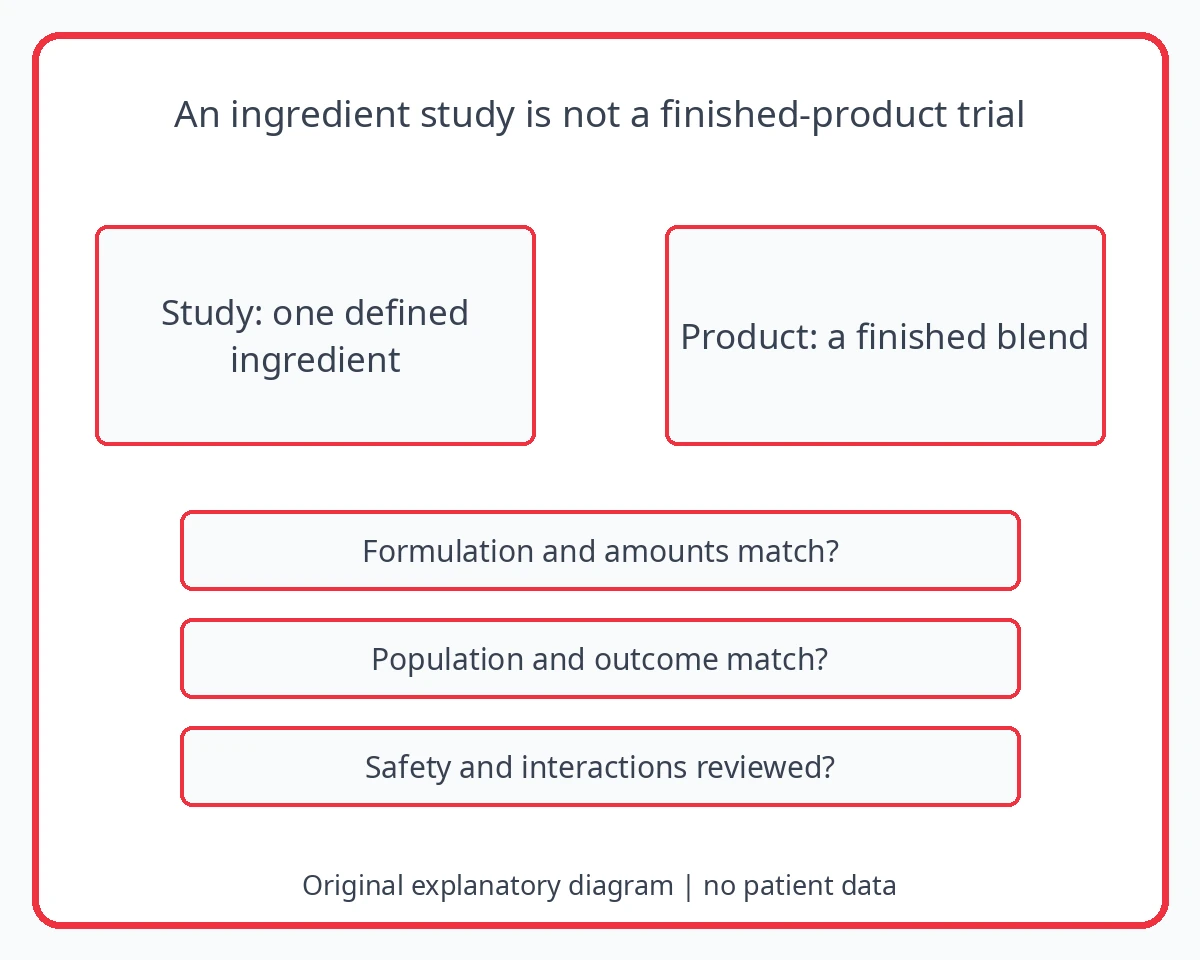
Compare the actual label with the studied intervention
NIH’s Office of Dietary Supplements explains that supplement labels and evidence need careful reading. Record the ingredients, amounts and formulation that are actually disclosed on the product. Then compare them with the intervention in the paper. A shared ingredient name does not establish that the blend, exposure or preparation is equivalent.
If an amount is not disclosed, leave that comparison unresolved. Do not copy an amount from another brand or assume the ingredients in a blend were studied together. A citation can be real while its application to the advertised product remains unsupported. The useful question is what the paper tested, not just whether a reference appears under the claim. [1]
For the distinction between somatropin and products marketed as HGH boosters, read HGHThai’s explanation of medicine identity
Name the outcome before calling it a benefit
FDA’s supplement-claim substantiation guidance emphasizes relevant evidence. Ask whether the research measured a short-term laboratory change, a symptom, daily function or another outcome. A higher hormone measurement does not by itself demonstrate better health or establish treatment of a deficiency. The outcome has to match the benefit being claimed.
Keep the participants, comparator, duration and uncertainty attached to the finding. Evidence from a different population or an acute experiment may not answer the product’s broad promise. US guidance is used here as an evidence-reading resource; it does not establish Malaysian approval, legality or availability for a particular product. [2]
A citation that does not establish a product match
This fictional example is a recording or evidence-reading exercise. It does not diagnose a condition or recommend a product, diet or exercise program.
| Observation or question | Available detail | What remains separate |
|---|---|---|
| Research intervention | One defined ingredient and preparation | Read the actual methods |
| Advertised product | Multi-ingredient blend | Finished formulation differs |
| Amounts | Some blend amounts are not disclosed | Equivalence cannot be assumed |
| Claimed benefit | Broad “hormone boost” wording | Ask which health outcome is supported |
| Safety question | Compatibility with current medicines unresolved | Efficacy evidence and interaction review are separate |
A real paper can still be the wrong evidence for the label
In the fictional advertisement, the ingredient name appears both in the paper and on the blend’s label. That match is only one part of the comparison. Unknown amounts and other ingredients prevent the reader from treating the blend as the same intervention.
Even a closer product match would leave the outcome question: did the study measure the health benefit the advertisement promises? A short-term marker result cannot be promoted to improved strength or longer life by enlarging the percentage in the headline. Identify the unanswered step rather than assuming the citation has supplied it.
For an example of an acute hormone result being overextended, see Fasting and Growth Hormone Headlines: Questions About the Evidence
Keep safety review separate from marketing confidence
NIH ODS notes that supplements can have risks and interactions, and “natural” is not a guarantee of safety. Manufacturing or quality-seal claims concern different questions from demonstrated benefit. Do not treat a polished label, testimonial or evidence citation as confirmation that a product is compatible with prescribed treatment.
If considering a product, bring its exact label and your current medicine information to a clinician or pharmacist. Say whether it is already being used or only being considered. This article endorses no supplement and provides no hormone-optimization target; it helps turn a broad claim into specific, answerable evidence questions. [1]
Bring product details to a medicine review using Discussing Other Medicines and Supplements During Hormone Care
A claim review is not an endorsement or a local approval check
No supplement is endorsed or recommended as a hormone treatment. US regulatory guidance is used for evidence-reading principles, not as a statement of local legal status.
Sources and reading context
- NIH ODS dietary supplements information — Ingredient disclosure and claim assessment; no endorsement of hormone boosters
- FDA substantiation of supplement claims — Evidence and claims evaluation; US guidance not local legal permission