Fasting and Growth Hormone Headlines: Questions About the Evidence
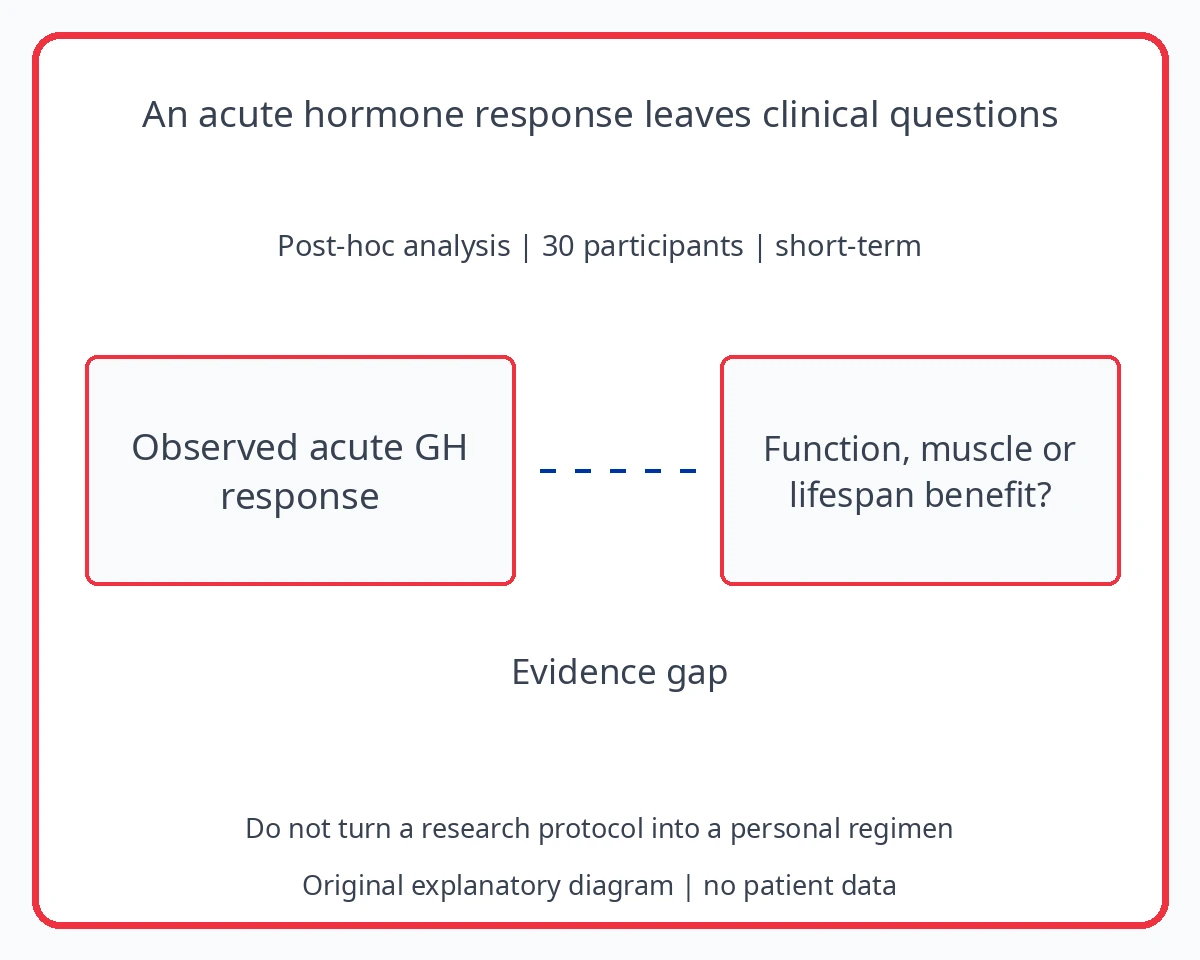
A short-term growth-hormone response during fasting is not the same outcome as stronger muscles, better daily function or longer life. To read a fasting headline, identify the actual study and ask which of those outcomes it measured. A striking hormone percentage cannot fill a gap in clinical evidence.
On this page
- Identify the paper and the analysis it actually reports
- Read the size of a change with its denominator
- From an acute observation to an unsupported headline
- Repeating the hormone number does not bridge the outcome gap
- Keep evidence reading separate from choosing a fasting plan
- No fasting regimen or hormone target is recommended
- Sources and reading context
Identify the paper and the analysis it actually reports
The cited Frontiers paper was published on 7 February 2025, although 2024 appears in its DOI and volume label. It reports a post-hoc analysis of 30 apparently healthy participants from a randomized crossover study involving a 24-hour fasting condition and an eating condition. These details identify the research setting; they are not a personal fasting instruction.
A secondary analysis of trial data is not automatically a new confirmatory experiment for every question later asked of it. Read the authors’ methods and limitations, including the population, measurements and timing. The presence of “randomized” in the parent design does not turn an unmeasured long-term benefit into an observed result. [1]
For matching claims to the observed duration, read Short and Long Follow-Up: Reading Growth-Treatment Studies
Read the size of a change with its denominator
The paper reports larger relative GH increases in a lower-baseline subgroup. A percentage is calculated relative to its starting value, so the baseline matters to how striking the number looks. Do not detach the percentage from the subgroup definition or treat it as a universal response expected from every person who fasts.
FDA’s biomarker resources distinguish a measured biological marker from a clinical outcome and emphasize the context needed for a surrogate. A GH change in this acute study does not itself establish muscle gain, improved function, longevity or treatment of GH deficiency. Those claims need evidence about the relevant outcome in the relevant population. [1] [2]
From an acute observation to an unsupported headline
The study-design rows refer to the cited paper. The “anti-aging” headline is an illustrative overstatement, not a quotation from the authors.
| Evidence or observation | What is available | What it does not establish |
|---|---|---|
| Analysis | Post-hoc evaluation involving 30 participants | Not a large long-term confirmatory trial |
| Study setting | Acute fasting/eating crossover conditions | Not a tested personal regimen for every reader |
| Observed subject | GH and other short-term measured parameters | Not direct observation of longer life or better function |
| Illustrative headline | “A hormone increase proves anti-aging benefit” | Adds a clinical outcome the observation does not supply |
| Remaining question | Does the change lead to the claimed useful outcome? | Requires separate appropriate evidence |
Repeating the hormone number does not bridge the outcome gap
The fictional headline changes an acute hormone observation into a claim about aging. The missing step is not a larger font or another calculation of the same percentage. It is evidence that the observed change leads to the claimed health outcome under conditions relevant to the reader.
A faithful summary names the short-term measurement and the analysis limits. It can describe an interesting biological finding while leaving longevity or functional benefit unanswered. The same discipline applies even when the headline appears beside a real citation.
For the broader distinction between markers and health outcomes, see A Biomarker Change Is Not the Same as a Health Benefit
Keep evidence reading separate from choosing a fasting plan
Do not turn the study protocol into a schedule to follow or combine it with hormone medicines to pursue a higher number. The article evaluates how a claim is supported; it does not assess whether fasting is suitable in a person’s medical situation. That question needs individualized advice, particularly when medicines or health conditions are involved.
When discussing the paper, bring the exact outcome and the claim you want to understand. “Does this study show improved daily function?” is more focused than “Does fasting boost HGH?” The narrower question makes it easier to see where the evidence ends without dismissing the biological observation or exaggerating its practical meaning. The same outcome check helps with supplement advertisements that promise a hormone boost; compare the actual product with the intervention studied as well.
No fasting regimen or hormone target is recommended
No fasting duration, dietary regimen or hormone optimization target is recommended. The cited analysis does not establish a treatment for GH deficiency or a longevity benefit.
Sources and reading context
- Primary fasting secondary analysis (published 2025) — Acute post-hoc analysis, 30 participants; short-term hormone response is not clinical benefit. DOI includes 2024 but publication is 7 Feb 2025.
- FDA surrogate endpoint resources — Surrogate validation is context-specific; IGF-1 change is not a validated general anti-aging outcome